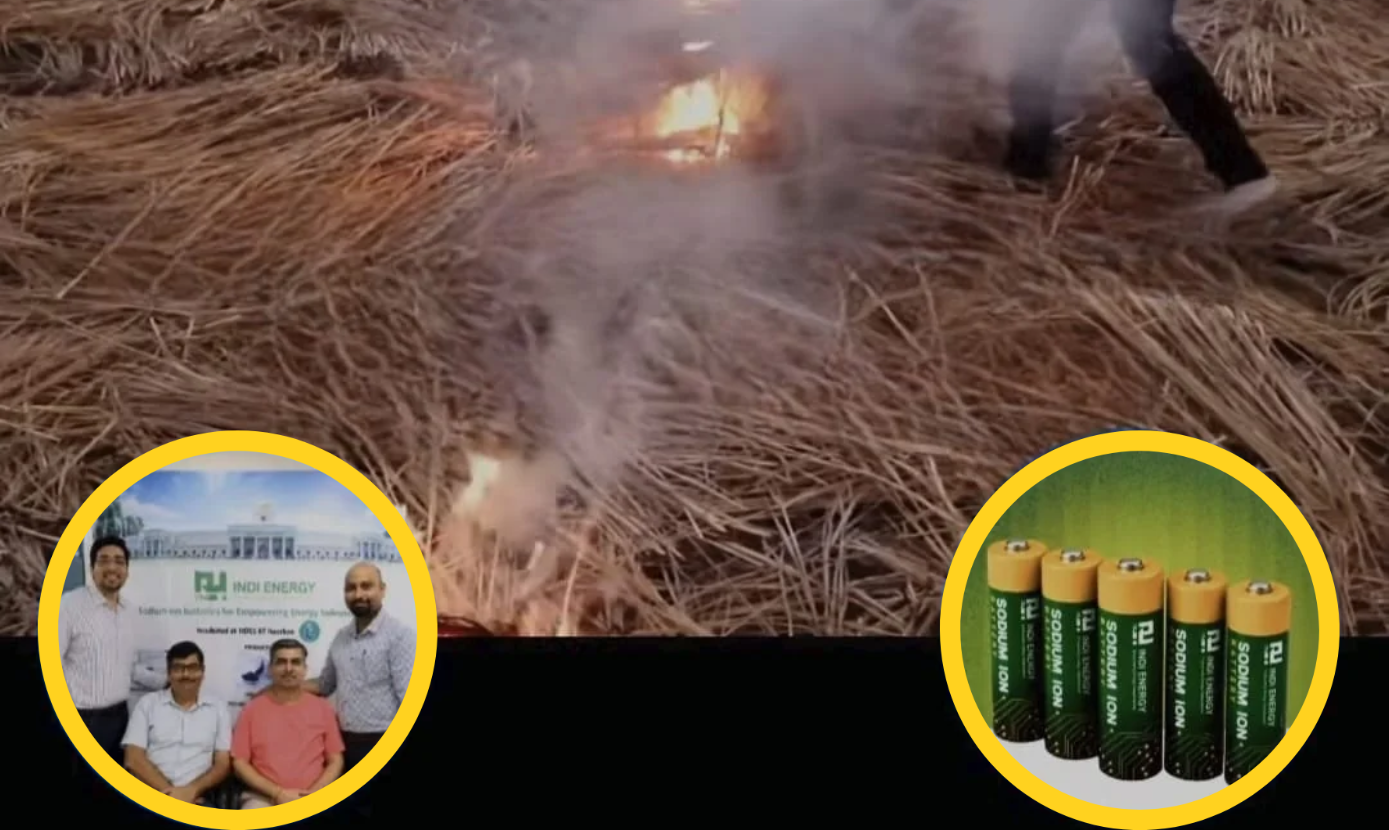
From discarded rice straw and sugarcane residue to advanced battery materials, IndiEnergy is exploring how agricultural waste can become a valuable resource for India’s growing energy storage industry.
India produces large amounts of agricultural residue every year. Much of this waste has limited economic value and is sometimes burned, contributing to air pollution. But what if these discarded materials could become an important part of the country’s clean energy transition?
This is the challenge that Roorkee-based startup IndiEnergy is working to address.
Founded in 2019, the company is developing advanced materials for sodium-ion batteries by using agricultural waste as a key raw material. Its innovation focuses on converting rice straw, sugarcane bagasse and other biomass residues into a specialised carbon material called BioBlack.
Giving Agricultural Residue a New Purpose
At the centre of IndiEnergy’s work is BioBlack, a hard-carbon material designed for use as the anode in sodium-ion batteries.
Unlike conventional battery materials, this approach begins with agricultural by-products. Through material science and engineering processes, the startup transforms biomass waste into carbon with a structure suitable for storing sodium ions.
Hard carbon plays an important role in sodium-ion battery technology. Its internal pores and irregular structure help accommodate and store sodium ions during battery operation.
According to the company, BioBlack has demonstrated a reversible capacity of up to 330 mAh/g at 1.0 V, along with a plateau capacity reaching 250 mAh/g at 0.2 V.
Building Battery Technology Through Research
The development of BioBlack involved collaboration with scientists at the Indian Institute of Technology (IIT) Roorkee. The work combines scientific research, engineering and experimentation to develop high-performance carbon materials from agricultural residues.
IndiEnergy has also developed sodium-ion battery cells using its BioBlack technology. One of its products is the Sodium 26700 cylindrical cell, designed for practical energy storage applications.
The cell has a nominal voltage of 3.0 V, a capacity of 3.2 Ah and an energy output of 9.6 Wh. The company reports an energy density of 100–140 Wh/kg and a cycle life of more than 3,000 cycles.
Its stated operating range includes discharge temperatures from -40°C to +60°C and charging temperatures from -10°C to +55°C.
Applications Beyond Conventional Batteries
IndiEnergy aims to take its sodium-ion technology beyond laboratory research and into real-world applications.
The company identifies several potential markets, including stationary energy storage, electric mobility, starter batteries, UPS systems, inverters and solar streetlights.
Sodium-ion batteries are attracting attention as an alternative energy storage technology. Their development could help diversify battery material choices and support the growing demand for energy storage solutions.
Government Support for Commercialisation
An important development came on 2 April 2026, when the Technology Development Board (TDB), operating under the Department of Science and Technology, announced financial assistance to IndiEnergy.
The support is intended to help commercialise its hard-carbon technology developed from agricultural and biological waste.
This assistance marks an important step in moving the company’s research towards wider industrial applications.
The Team Behind the Innovation
IndiEnergy was co-founded by four individuals with backgrounds in research, engineering and battery technology.
The founding team includes Professor Yogesh Sharma, an IIT Roorkee professor; Akash Soni, an IIT Roorkee graduate; Dr. Asit Sahoo, who leads battery technology; and Dr. Nagesh Kumar, who heads research and innovation.
Together, the team is working to develop battery technologies that combine scientific research with the practical use of locally available resources.
A Bigger Opportunity for India’s Energy Future
IndiEnergy’s work represents an interesting connection between two important sectors: agriculture and energy.
By finding new uses for agricultural residues, the company is exploring an opportunity to create additional value from materials that might otherwise be discarded. At the same time, developing domestic battery materials could contribute to India’s efforts to strengthen its energy storage manufacturing ecosystem.
The larger idea is simple but powerful: waste from one industry could become a valuable resource for another.
As India moves towards cleaner energy and greater domestic manufacturing capabilities, innovations like BioBlack could open new possibilities for both agricultural waste management and battery technology.