Sometimes, a change in plans can lead to an entirely new path.
For Sona Misra, that path began far away from the farms she runs today.
Coming from Kanpur, Sona built her academic career around science. She studied Biology, completed her Master’s in Biotechnology, and worked as a researcher in laboratories across Delhi-NCR. In 2012, she joined a PhD programme at Gautam Buddha University, where her work focused on cancer and stem cells.
But her journey in academics did not go as planned.
After facing challenges during her PhD, Sona decided to leave the programme in 2015. She later cleared another PhD entrance examination, but completing the programme would have required several more years of commitment.
Instead of starting again, she chose a different direction.
She continued researching independently and began looking closely at the problems in Indian agriculture. With her background in biotechnology, Sona started exploring whether science and technology could help make farming more efficient.
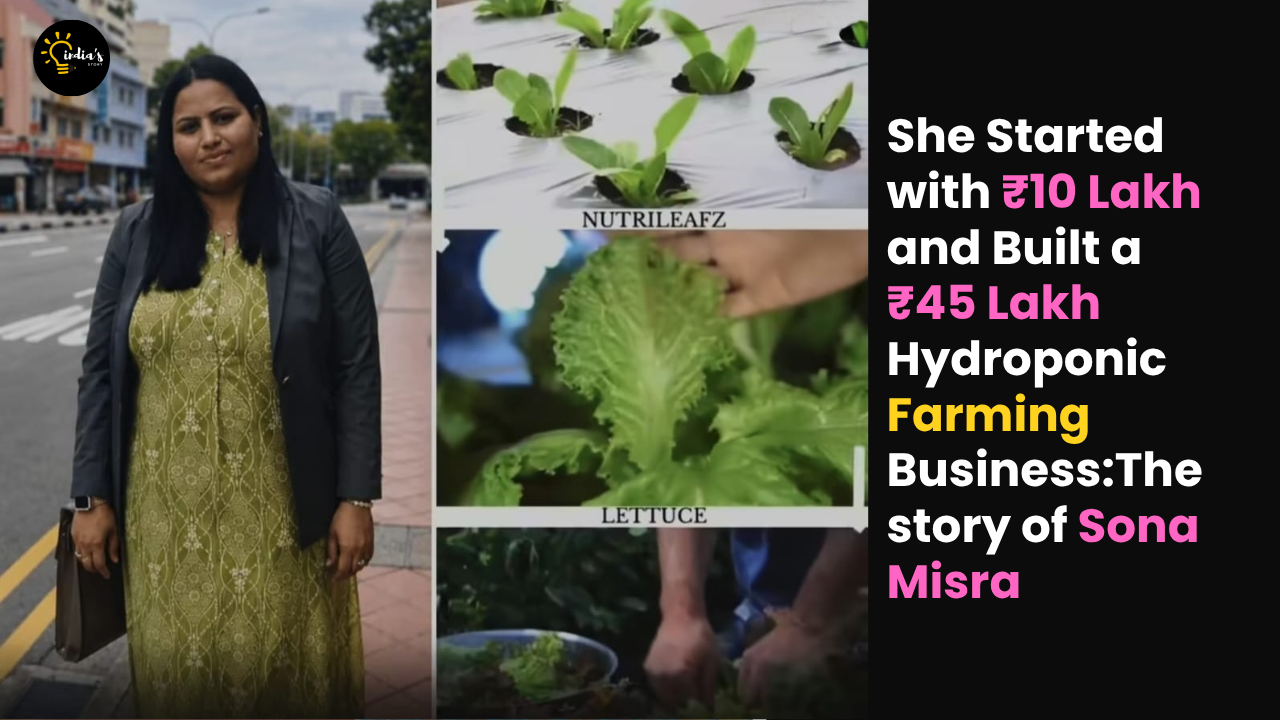
That idea eventually led to NutriLeafz.
A ₹10 Lakh Experiment on a Rooftop
Around 2019–20, Sona began experimenting with hydroponic farming in Noida.
She invested around ₹10 lakh to create a temperature-controlled farming setup on the rooftop of a commercial building. The facility had space for around 4,000 plants.
Instead of focusing on just one crop, she experimented with more than 20 varieties. Lettuce, herbs, cucumbers, bell peppers, cherry tomatoes and different microgreens were all part of her early trials.
The quality of the produce helped her attract orders from customers in premium residential areas.
The experiment was successful from a farming point of view. But there was another problem.
A 4,000-square-foot rooftop was simply not large enough to build a scalable commercial operation.
So, Sona decided to take a bigger step.
From a Rooftop to a One-Acre Farm
In 2021, she leased a one-acre property in Sector 137, Noida.
The location already had a structure, but it was in poor condition and needed significant work. Sona invested around ₹12 lakh to restore the facility and turn it into a commercial hydroponic farm.
This time, the focus was mainly on bell peppers and cherry tomatoes.
The farm generated around ₹6–7 lakh in revenue during 2021–22.
However, growing the business brought new challenges.
The groundwater quality was poor. The land was saline and infertile. Maintenance costs were high, and managing operations across different locations required constant travel and supervision.
Although the farming technology was working, running the business efficiently was becoming difficult.
In 2022, Sona decided to shut down her Noida operations and start again in a new location.
A Fresh Start in Mathura
Sona found a 15-acre plot in Bathain Khurd, near Kosi Kalan in Mathura.
The new location offered more space and lower operating costs, but it was not without problems. The soil was saline, and the groundwater quality was poor.
Instead of abandoning the plan, she worked around these challenges.
RO systems were installed to improve water quality, and a 3-acre soilless hydroponic farm was developed using cocopeat as the growing medium.
This became the new home of NutriLeafz.
Today, the farm mainly grows three crops:
Cucumbers. Bell peppers. Cherry tomatoes.
Each crop follows a different production cycle.
Cucumbers are grown in cycles of around three to four months, with each cycle producing approximately 30–35 tonnes. Bell peppers take around nine months and produce roughly 15–16 tonnes per cycle.
The farm also grows around 12,000 cherry tomato plants, producing close to 12 tonnes in a cycle.
Building More Than Just a Farm
NutriLeafz is not only about growing vegetables.
The farm has also created work opportunities for around 100 women from nearby villages.
They are involved in different farm activities, including pruning, cutting and harvesting.
Building a technology-driven farm in a rural area has brought its own difficulties. Power cuts and voltage fluctuations have affected equipment and, in one instance, a prolonged disruption in water supply damaged standing crops.
To reduce dependence on the regular electricity supply, the farm added solar support to its operations.
Despite the challenges, Sona continued building the business step by step.
Growing the Business Through B2B
NutriLeafz initially sold directly to consumers.
However, as production increased, handling deliveries and logistics with a small team became difficult. The company gradually shifted towards a B2B model, allowing it to sell larger volumes through distribution and wholesale channels.
Today, the business generates approximately ₹40–45 lakh in annual revenue from its hydroponic farming operations.
From Research to Revenue
Sona Misra did not begin her career with a dream of becoming a farmer.
Her journey started in laboratories and classrooms. A difficult experience during her PhD forced her to rethink her future.
Instead of seeing that moment as the end of her career, she chose to explore another possibility.
Years later, that decision has grown into NutriLeafz a technology-driven farm producing tonnes of fresh vegetables while also creating employment opportunities for rural women.
From biotechnology research to hydroponic farming, Sona’s story shows that sometimes leaving one path can be the first step towards building something completely new.