
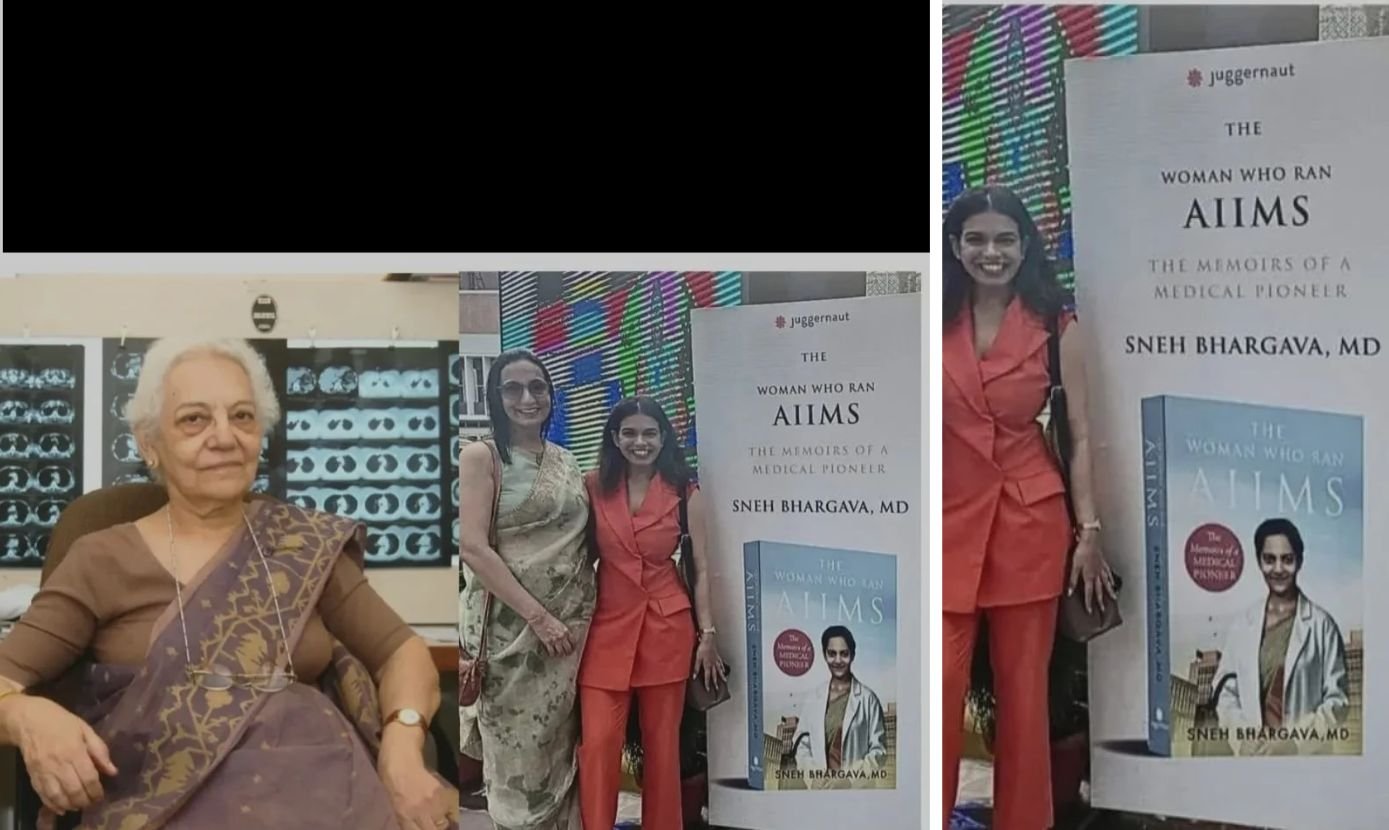
A young girl who lost her home during Partition went on to become one of India’s most respected medical pioneers. Dr. Sneh Bhargava broke barriers in radiology, championed advanced medical technology and made history as the first woman Director of AIIMS.
In 1947, as India was going through Partition, 17 year-old Sneh Bhargava had to leave her home in Jhelum and move to Ferozepur with her family. Like millions of others, she experienced the uncertainty and loss that came with the division of the country. But the difficult circumstances did not take away her determination to build a meaningful future.
She remained committed to education and chose medicine as her career. After completing her medical studies at Lady Hardinge Medical College in Delhi, she developed a strong interest in radiology, a field that was still struggling to gain recognition in India’s medical community.
At a time when radiology was often misunderstood as a profession limited to taking X-ray images, Bhargava recognised its greater importance. She believed that medical imaging could help doctors understand diseases more accurately and improve patient care.
Taking Indian Radiology to New Heights
In 1955, at just 25, she travelled alone to London for advanced medical training. She joined Westminster Hospital, where she was the only woman working in the radiology department.
This experience strengthened her knowledge and gave her a wider vision for the future of medical imaging in India. She returned home determined to develop radiology as an important medical speciality.
Beginning her professional career in 1958, she worked at a time when the field had limited resources and recognition. However, she continued to advocate for better equipment, advanced training and stronger medical infrastructure.
One of her most significant contributions came with the introduction of CT scan technology at AIIMS. Understanding the possibilities of this new technology, she worked to convince decision makers of its importance. Funding was difficult to secure, but she used clinical evidence and medical data to support her case.
Her efforts helped AIIMS acquire its first CT scanner in 1978, making it the first hospital in South Asia to have this technology.
She also encouraged the wider use of ultrasound and worked to establish radiology as a specialised discipline. For her, medical imaging was never just about machines. She believed that doctors must understand scan results in the context of each patient’s medical history and personal experience.
Breaking Barriers at AIIMS
In 1984, Dr. Bhargava was appointed Director of the All India Institute of Medical Sciences (AIIMS), becoming the institution’s first woman to hold the position.
Her appointment was an important moment for women in Indian medicine. She entered a leadership position where women had rarely been seen at the highest levels of authority.
Her leadership was soon tested during one of India’s most difficult political periods. Following the assassination of Prime Minister Indira Gandhi, the country witnessed widespread unrest. Bhargava demonstrated courage and responsibility during this difficult time. She supported her staff, offered shelter and helped organise medical assistance when it was needed.
Her approach to leadership reflected a strong sense of duty towards both healthcare workers and patients.
A Lifetime Dedicated to Learning
Dr. Bhargava’s achievements were not limited to administrative positions or medical technology. She spent decades training young doctors, strengthening medical education and encouraging new generations to explore radiology.
Even in her later years, she continued to remain active and curious. She worked well into her 90s, developed an interest in yoga during that period and wrote her memoir, The Woman Who Ran AIIMS, at the age of 95.
Her journey is a powerful reminder that difficult beginnings do not have to determine the direction of a person’s life.
From leaving her home during Partition to introducing advanced medical imaging and leading one of India’s most prestigious medical institutions, Dr. Sneh Bhargava built a legacy through knowledge, courage and persistence.
Her story is not just about becoming the first woman Director of AIIMS. It is about changing the way an entire medical speciality was understood and proving that determination can open doors for generations to come.

